Encyclopedia Anachronistica


Standard
Inspiration
Asia
Chinese
Location
All enemies must spend 1 additional action to activate Dodge and Jump power abilities.
Only the front hall was completed before the Qin dynasty collapsed, but its 1,320-meter-by-420-meter foundation made it one of the largest ancient palaces ever conceived.
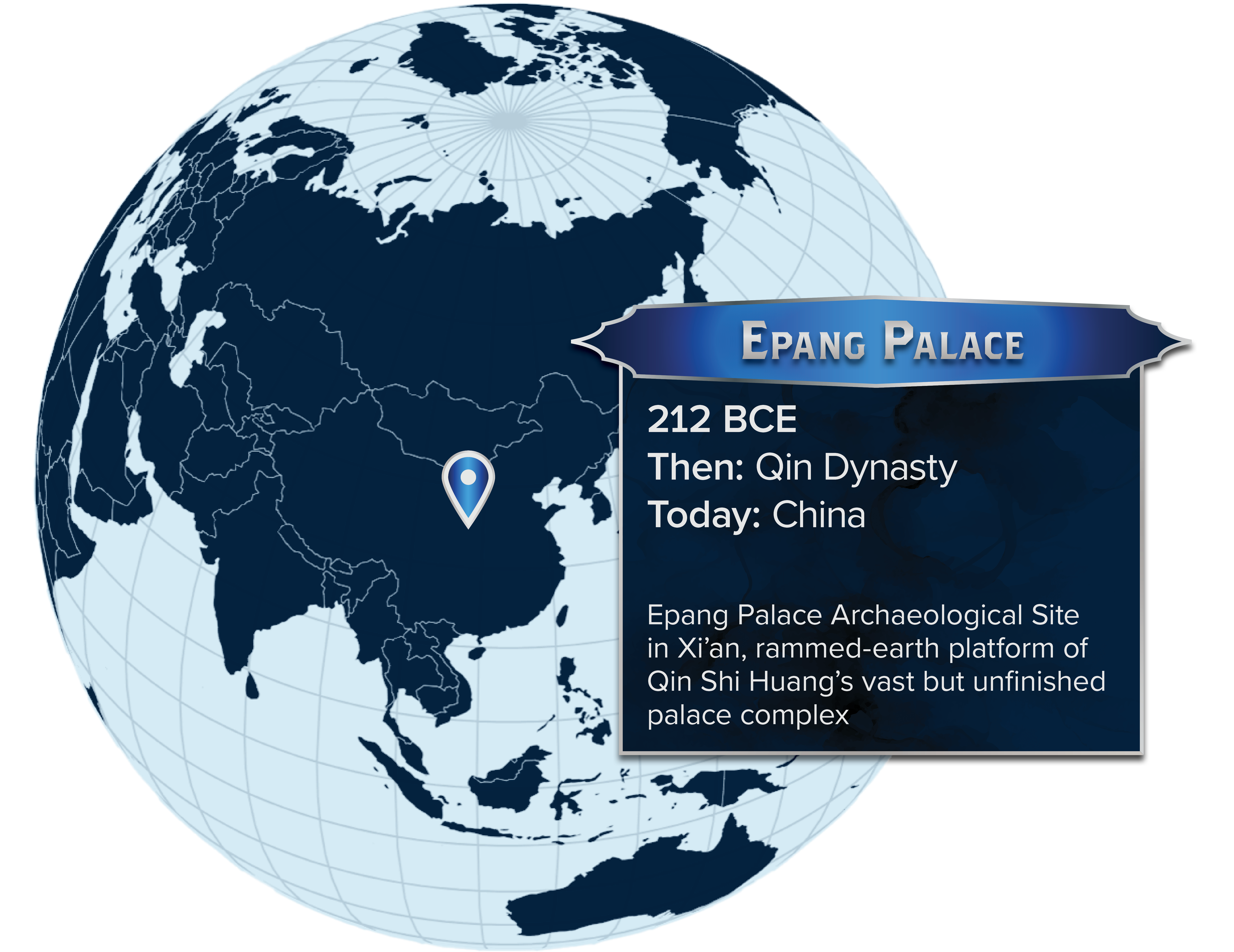
Epang Palace was a monumental palace complex commissioned by Qin Shi Huang after the unification of China in 221 BCE. Intended as the administrative and ceremonial heart of the new empire, it was conceived on a scale meant to surpass all earlier royal structures. Ancient texts describe vast halls, elevated terraces, and expansive courtyards symbolizing the emperor’s dominion over the “Four Corners” of the world. Archaeological evidence, however, suggests that during Qin Shi Huang’s lifetime the project may have advanced little beyond massive foundations, making Epang Palace as much a vision of imperial ambition as a completed structure.
Construction of the palace required extensive labor mobilization from across the empire. Its immense scale reflected the Legalist ethos of Qin governance, in which monumental architecture served to project authority, enforce unity, and embody the emperor’s mandate. Epang Palace was intended as a new imperial center, replacing the fragmented palatial traditions of the Warring States with a single locus of absolute rule.
After the fall of the Qin dynasty, historians later claimed that Epang Palace was burned during the rebellion led by Xiang Yu. Modern archaeology complicates this account, as no clear evidence of large-scale destruction has been found, suggesting that much of the complex may never have been fully built. Excavations near modern Xi’an have revealed extensive rammed-earth foundations consistent with ancient descriptions of an enormous, planned structure.
Today, Epang Palace stands as a symbol of both the grandeur and the excess of Qin imperial ambition. Protected as an important cultural and archaeological site, it continues to be studied as a case in early imperial planning and ideology. In Chinese cultural memory, Epang Palace represents Qin Shi Huang’s sweeping vision — and the fragility of power pursued at unprecedented speed.