Encyclopedia Anachronistica


Standard
Weapon
Europe
Greek
Utility
If this is the first revealed card in this Champion's loadout, spend 1 less action to attack with this weapon.
The embolon was a bronze plated prow designed to pierce an enemy ship's hull below its waterline. Attacking at an angle avoided entanglement as the enemy sank.
The embolon was the ancient equivalent of a battering ram strapped to the front of a speeding ship. If you picture a trireme slicing across the water, the embolon is the bronze “beak” at its bow—sharp, heavy, and built for one job: smashing holes in enemy hulls. It wasn’t decorative. It was the most important weapon in Greek naval warfare, turning the entire ship into a projectile. When a trireme hit at full speed, the impact could split planks, snap oars, and send enemy sailors scrambling for their lives.
Themistocles understood the power of the embolon better than almost anyone in his time. While other Greek leaders still thought of naval battles as floating infantry fights—where soldiers boarded enemy ships and fought hand-to-hand—Themistocles saw that the future belonged to speed and precision. A well-trained crew could use the embolon like a surgeon’s scalpel, not a sledgehammer. Instead of crashing straight into an enemy ship, Athenian captains often aimed to “shear” the opponent’s oars. One clean strike could leave a Persian trireme spinning helplessly in the water, unable to move or defend itself.
This tactic became the heart of Themistocles’ strategy at the Battle of Salamis. He lured the massive Persian fleet into the narrow straits, where their numbers became a disadvantage. The Persian ships were packed so tightly that they could barely turn. The Athenian triremes, lighter and more maneuverable, darted between them. Each time an Athenian ship accelerated, the embolon became a bronze spear aimed at the enemy’s ribs. Ancient writers describe the sound of rams hitting wood—crunching, splintering, echoing across the water—as ship after ship was disabled or sunk.
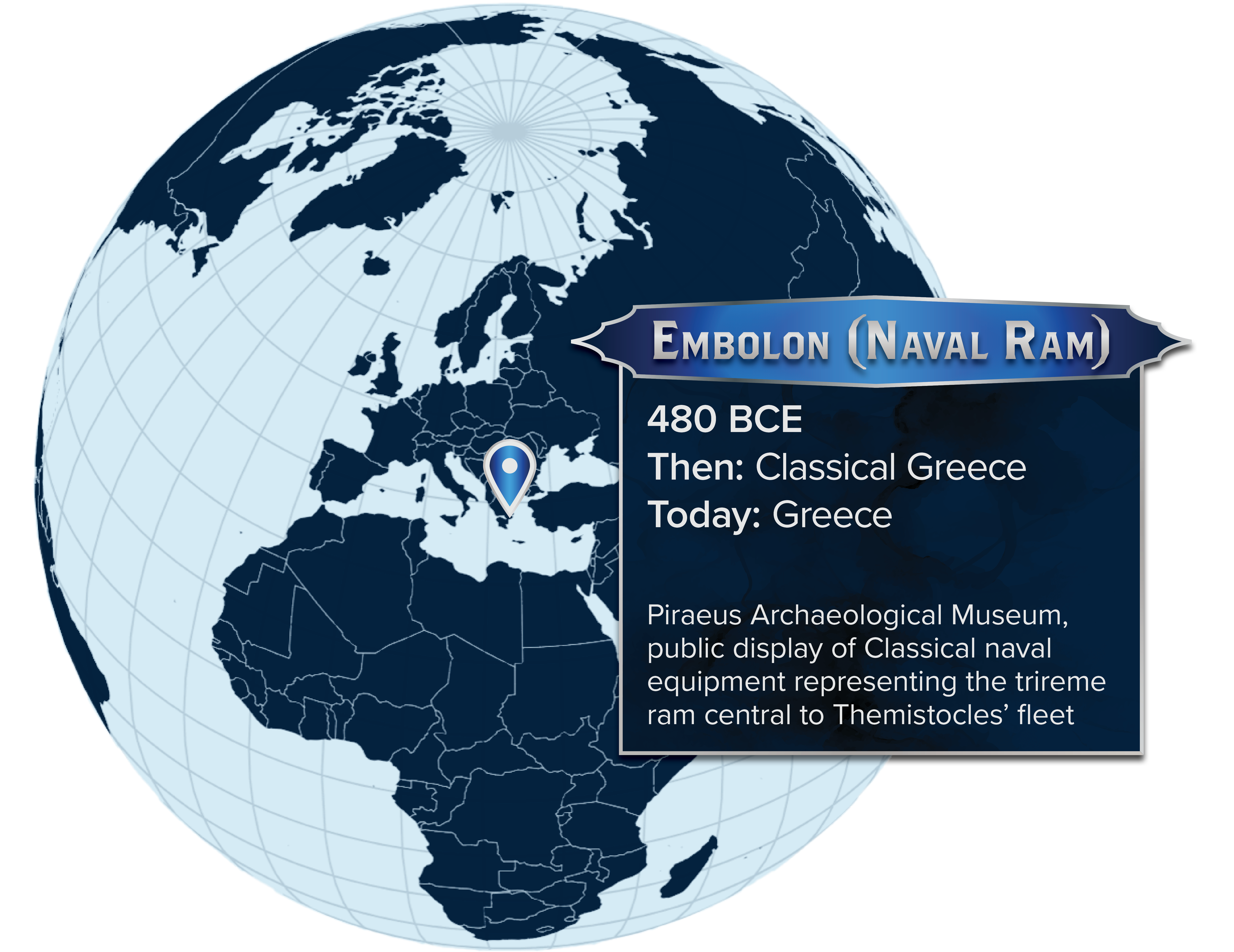
Archaeologists have recovered several ancient rams from shipwrecks, and they’re surprisingly sophisticated. Many were cast in one piece, with internal ribs that helped distribute the force of impact. They weren’t just heavy; they were engineered. Museums like the Piraeus Archaeological Museum display these rams today, and students can see the dents and scratches left from real battles. It’s a reminder that ancient warfare wasn’t primitive, it was highly technical.
The embolon still matters today because it shows how technology can reshape an entire military system. Themistocles didn’t win at Salamis because he had more ships; he won because he understood what the embolon made possible. Modern naval academies study the battle to show how innovation, training, and terrain can overturn overwhelming odds. For students, the embolon is a perfect example of how a single piece of equipment—small compared to the whole ship—can change the destiny of a city and, in this case, the future of Greece itself.