Encyclopedia Anachronistica

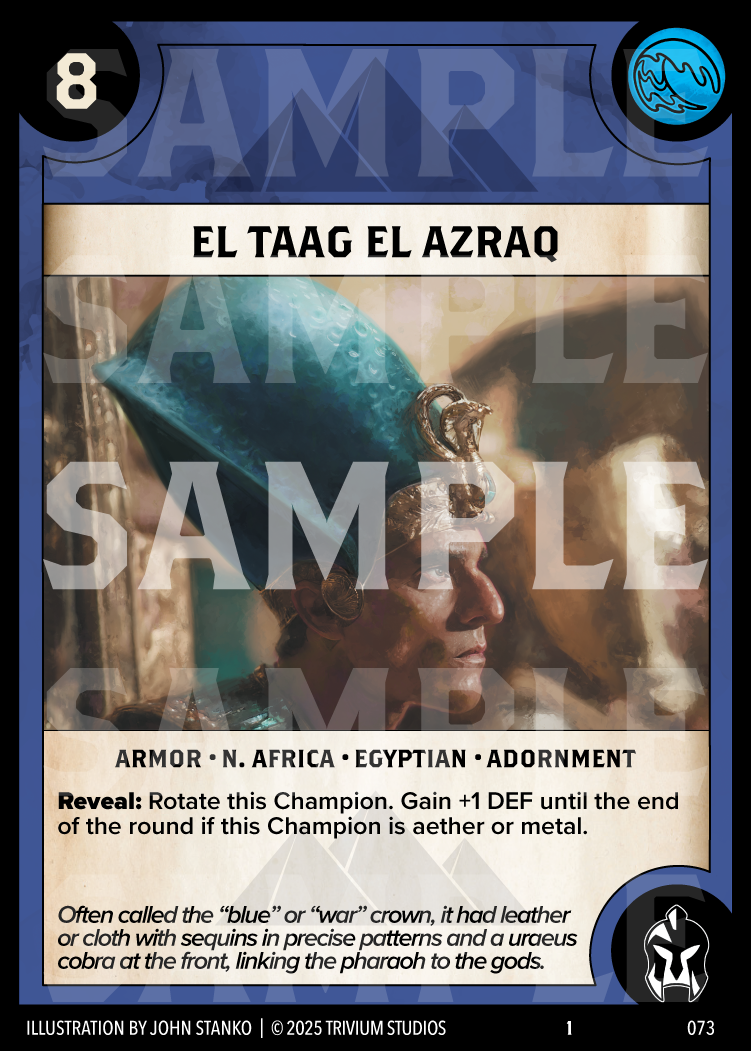
Standard
Armor
N. Africa
Egyptian
Adornment
Reveal: Rotate this Champion. Gain +1 DEF until the end of the round if this Champion is aether or metal.
Often called the "blue" or "war" crown, it had leather or cloth with sequins in precise patterns and a uraeus cobra at the front, linking the pharaoh to the gods.
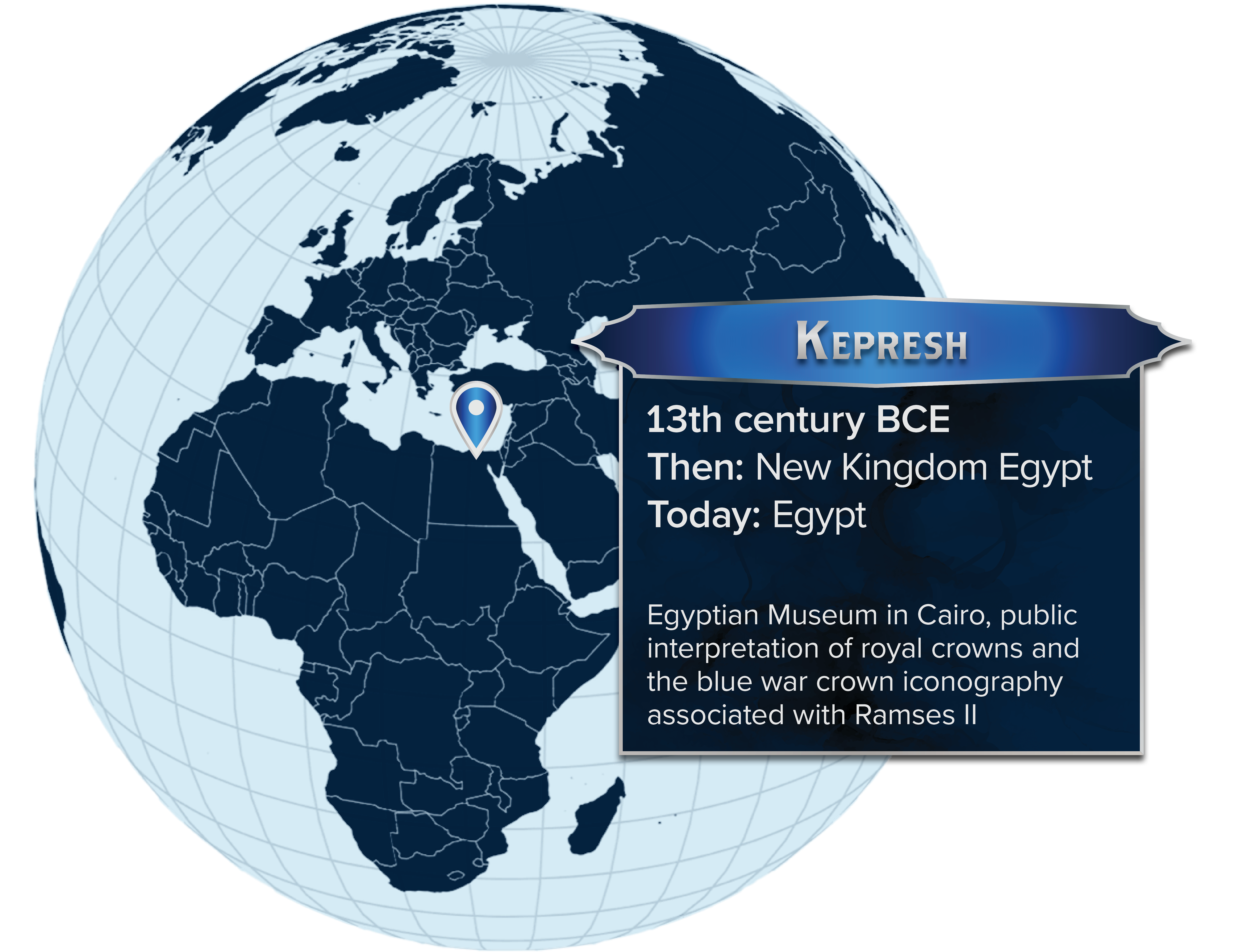
The Blue Crown, known to the Egyptians as the khepresh, is one of the most striking pieces of royal regalia from the New Kingdom. Unlike the tall White Crown or the sweeping Red Crown, the khepresh wasn’t tied to a specific region of Egypt. Instead, it was a crown of action—a battle helmet, a ceremonial badge of command, and a visual declaration that the king was stepping onto the stage as Egypt’s living champion. Made of leather or cloth and covered in hundreds of small, raised discs, the crown shimmered in the sun like a field of blue fire. When a pharaoh wore it, he wasn’t just a ruler; he was a force.
The khepresh rose to prominence during the 18th Dynasty, but it reached its iconic form under Ramesses II. In temple reliefs from Abu Simbel, Luxor, and the Ramesseum, Ramesses charges into battle wearing the Blue Crown, reins tied around his waist so both hands could pull his bow. The crown became his signature look, the visual shorthand for a king who wanted to be remembered as a warrior without equal. Even in scenes of diplomacy or ritual, the khepresh appears as a symbol of readiness—a reminder that the pharaoh’s job was to defend Egypt’s borders and uphold Ma’at, the cosmic order.
The discs that cover the crown are often mistaken for jewels, but they likely represented protective magic. Some scholars believe they echo the scales of a divine creature or the stars of the night sky, linking the king to cosmic power. Others see them as a stylized version of the military helmets worn by elite chariotry. Either way, the effect was the same: the king appeared armored in symbolism, a living embodiment of divine authority and military might.
The khepresh also played a role in royal propaganda. When Ramesses II carved the Battle of Kadesh across temple walls, he made sure to depict himself wearing the Blue Crown in every major scene. It didn’t matter that the battle was a stalemate; the imagery told a different story. The khepresh became part of the myth—Ramesses the unstoppable, Ramesses the chosen of Ra, Ramesses the warrior‑king who stood alone against thousands. The crown turned a complicated military encounter into a legend of personal heroism.
Today, the Blue Crown survives only in stone carvings and painted reliefs, but its impact is unmistakable. It shows how the Egyptians used clothing as political technology, transforming a simple headpiece into a symbol of national identity. When students see the khepresh on a statue or temple wall, they’re looking at more than a crown—they’re seeing the ancient world’s version of a battle standard, worn not by an army, but by a single man who wanted to be remembered forever.