Encyclopedia Anachronistica


Standard
Weapon
Europe
Greek
Polearm
When this Champion hits with this weapon, move one space. If this Champion is brown, cyan, or yellow, instead move up to two spaces.
The dory is a thrusting spear of ash or cornel wood used by hoplites in tight formation. Its iron head and butt spike gave reach, balance, and attack options.
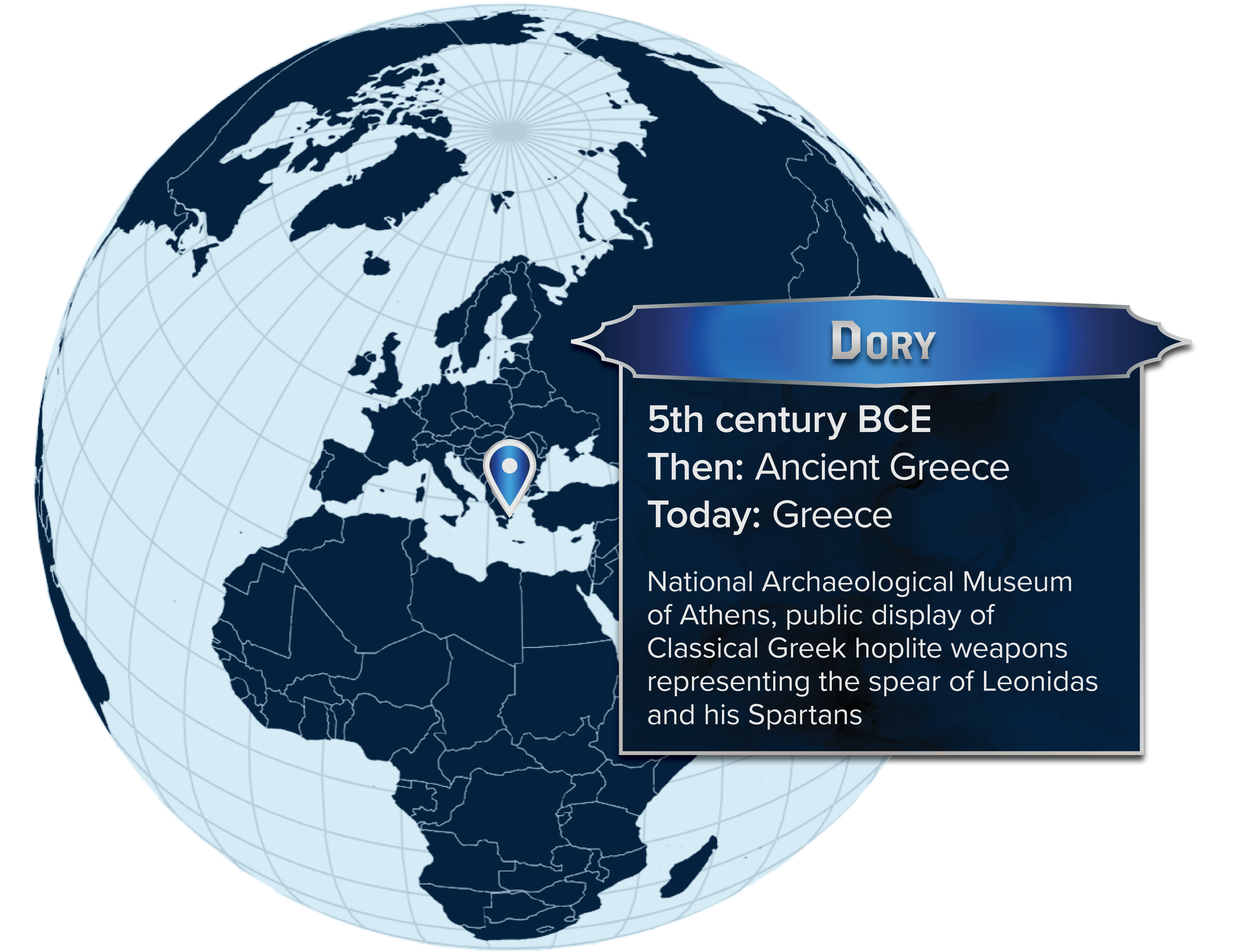
The dory was the defining weapon of the classical Greek hoplite and the primary tool that gave the Spartan phalanx its terrifying unity. Measuring roughly 2.1 to 2.7 meters (7 to 9 feet), this spear featured a leaf-shaped iron head for piercing armor and a bronze butt spike known as the sauroter—the "lizard-killer." This spike served a dual purpose: it acted as a counterweight to make the spear easier to handle and provided a secondary point to strike downward or use if the main spearhead snapped in the heat of battle.
King Leonidas and his Spartans were molded by the dory from a young age through the agōgē, Sparta’s brutal military training system. The spear was designed for the "push" of the phalanx, where soldiers stood shoulder-to-shoulder, overlapping their shields to create an unbroken wall of bronze and wood. At the Battle of Thermopylae in 480 BCE, the dory became a deadly instrument of defense. In the narrow mountain pass, the Spartans used the superior reach of their spears to keep the Persian forces at a distance, proving that a disciplined line of spearmen could hold back vastly superior numbers.
Archaeological discoveries across Greece, including iron spearheads and bronze butt spikes found in the region of Laconia, confirm the standardized design of this weapon. These finds highlight the advanced ironworking skills of the time and show that the dory was mass-produced to ensure every Spartan was equipped identically. Ancient historians like Herodotus often noted the contrast between the long, sturdy Greek dory and the shorter spears used by the Persian infantry, a difference in reach that frequently decided the outcome of hand-to-hand combat.
Today, the dory is one of the most iconic artifacts of ancient warfare. While the ash wood shafts have long since rotted away, the surviving metal pieces displayed in museums allow us to touch the reality of the hoplite experience. For modern historians and students, the spear remains a symbol of the courage and coordination displayed at Thermopylae—a reminder that the strength of the Spartan army did not come from individual warriors, but from a single, disciplined organism moving as one.