Encyclopedia Anachronistica

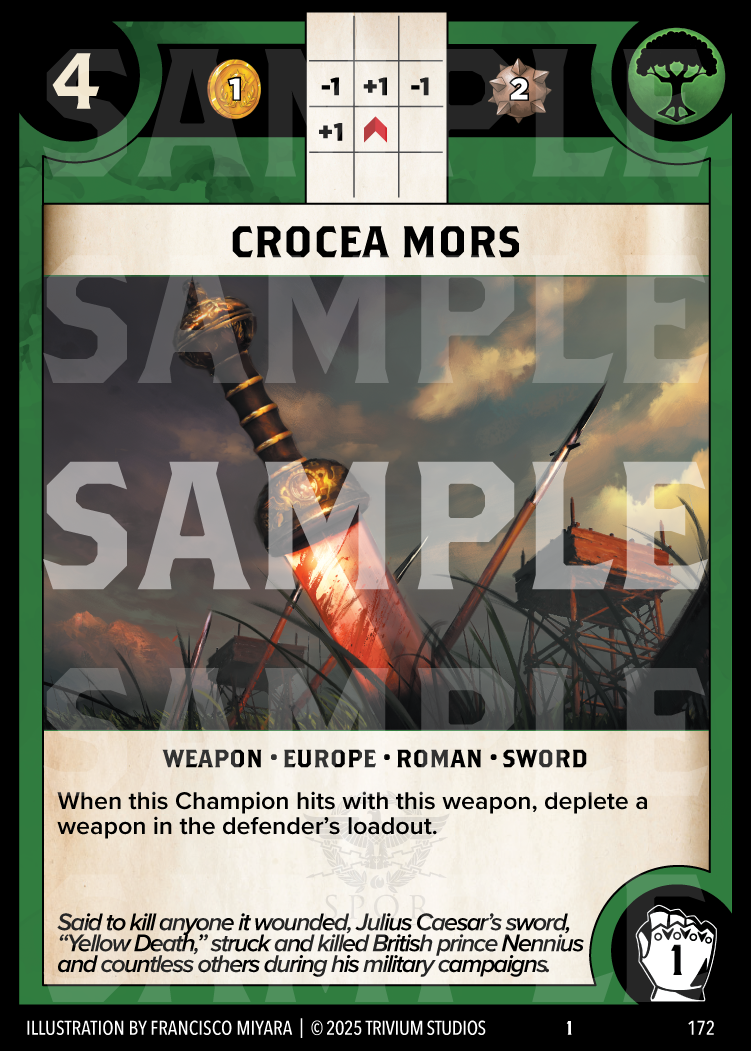
Standard
Weapon
Europe
Roman
Sword
When this Champion hits with this weapon, deplete a weapon in the defender's loadout.
Said to kill anyone it wounded, Julius Caesar's sword, "Yellow Death," struck and killed British prince Nennius oVoVoVo and countless others during his military campaigns.

Imagine the most powerful general in the world, Julius Caesar, standing on the windswept beaches of Britain, swinging a sword that gleams like pure sunlight. This is Crocea Mors, or the "Yellow (or Saffron) Death," a blade that medieval legends claim was so lethal that no one survived its touch. According to these grand tales, Caesar engaged in a desperate duel with a British prince named Nennius. During the struggle, Caesar’s golden sword became wedged so firmly in Nennius’s shield that the general was forced to retreat empty-handed. Nennius supposedly spent his final days using Caesar’s own legendary weapon to cut down Roman soldiers before he finally succumbed to his wounds, taking the sword to his grave as a trophy of British defiance.
It is a scene straight out of an action movie, but if we look at the actual evidence, the "Yellow Death" begins to fade into the mists of fiction. Julius Caesar was a meticulous record-keeper who wrote extensively about his campaigns in his own commentaries. While he was never shy about discussing his battles or his enemies, he never once mentions a prince named Nennius or the humiliating loss of his personal weapon. In reality, Caesar and his officers carried standard-issue Roman military gear made of high-quality iron and steel. A golden sword, while beautiful, would have been far too soft and heavy for the brutal reality of ancient combat.
The story of Crocea Mors did not actually appear until over a thousand years after Caesar’s death. It was popularized in the 12th century by Geoffrey of Monmouth, a writer famous for blending historical names with imaginative myths to create national epics, such as the legend of King Arthur and Merlin. For medieval audiences, these stories weren't about strict facts; they were about identity. By inventing a story where a local hero fought the mighty Caesar to a standstill, medieval writers were giving their ancestors a sense of legendary strength. Even if the sword never existed, the myth itself is a real piece of history that shows how every culture tries to rewrite its past to make its heroes look even more invincible.