Encyclopedia Anachronistica


Chrono
Inspiration
Europe
Greek
Divinity
Fates 1 of 3: Up to three Fates cards may be used this game. Reveal: Gain +1 base ATK until the end of the round.
Even gods feared the Fates, particularly Clotho spinning the thread of life. Her decisions were binding to all, part of a cosmic order even Zeus could not overturn.
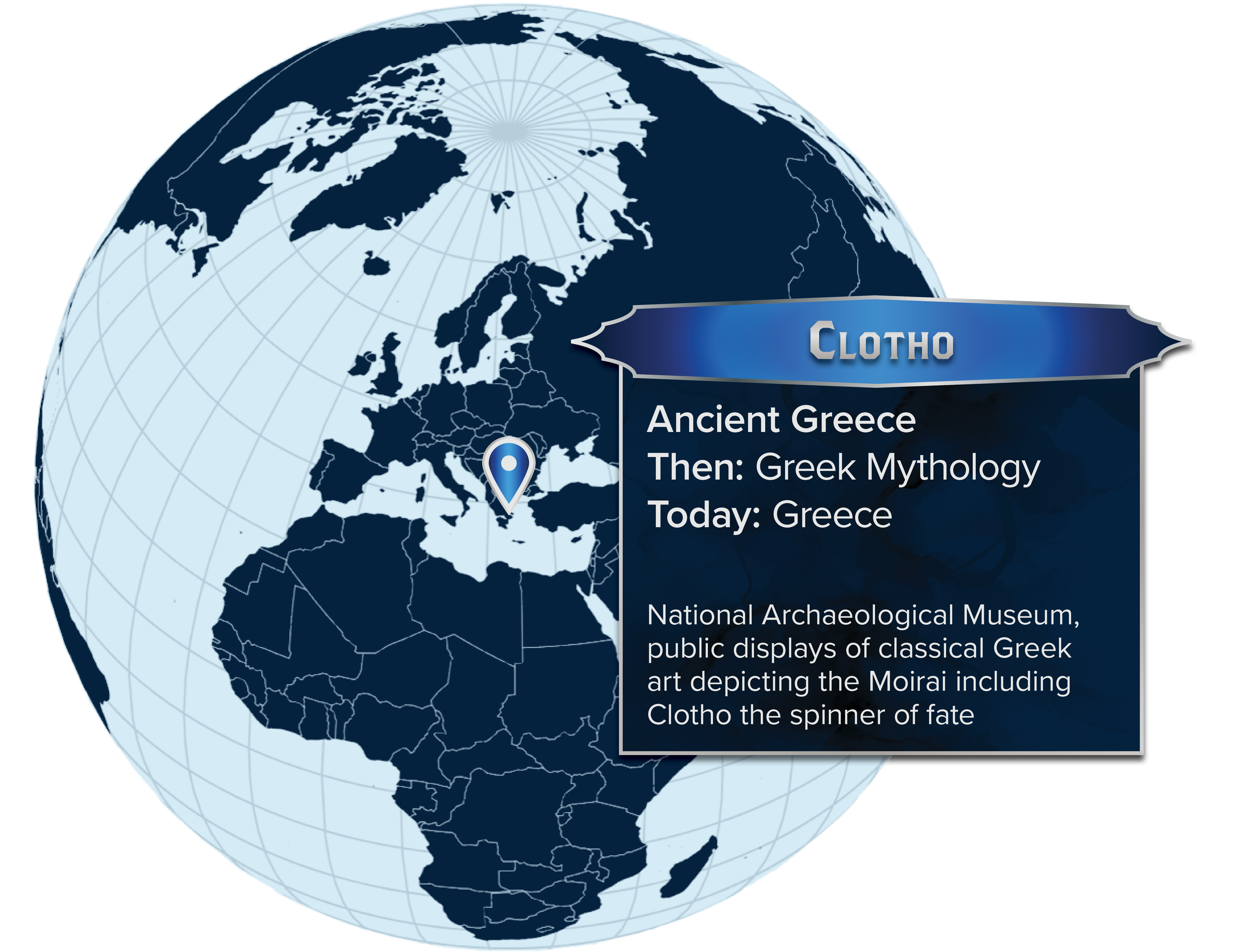
In the ancient Greek imagination, every human life was woven like a single, delicate strand of wool. At the center of this cosmic workshop stood the Moirai, the three Fates, who oversaw the lifespans of mortals and gods alike. Clotho, the youngest of the three, held the most vital role: she was the Spinner. Her name comes from the Greek verb klōthein, meaning “to spin,” a direct link to the textile work that was the heartbeat of every ancient Greek household.
The image of Clotho emerged more than 2,700 years ago during the Archaic period. To the Greeks, destiny wasn’t a vague concept; it was as physical as the wool being drawn through a woman’s fingers. Spinning was a constant, rhythmic sight in the ancient world, and poets like Hesiod used it as a metaphor to explain how a life begins. Clotho was depicted holding a spindle, drawing raw, chaotic wool into a neat, continuous thread. This first strand represented the moment of birth and the potential of a new life. While her sisters, Lachesis and Atropos, were responsible for measuring the length of the thread (how long their life would be) and eventually cutting it (their death), Clotho was the source—the one who set the story in motion.
Though Clotho is a figure of legend, she tells us a great deal about real Greek society. In a world without factories, weaving and spinning were essential for survival, tied to the labor and skill of women. By imagining the Fates as spinners, the Greeks elevated a common, everyday craft into a divine law. It was a way of saying that the universe had a rhythm and a plan, even if humans couldn’t always see it. On ancient pottery, Clotho is often shown as a calm, deliberate figure, emphasizing that destiny wasn’t a series of accidents, but a carefully managed balance.
Today, Clotho remains a powerful symbol of beginnings. Her legacy survives in our language every time we talk about a "thread of a story" or a "tightly woven plot." She reminds us how ancient people looked at the simple tools in their hands—a spindle and a handful of wool—and saw a way to explain the greatest mysteries of existence: where we come from and how our journeys begin.