Encyclopedia Anachronistica

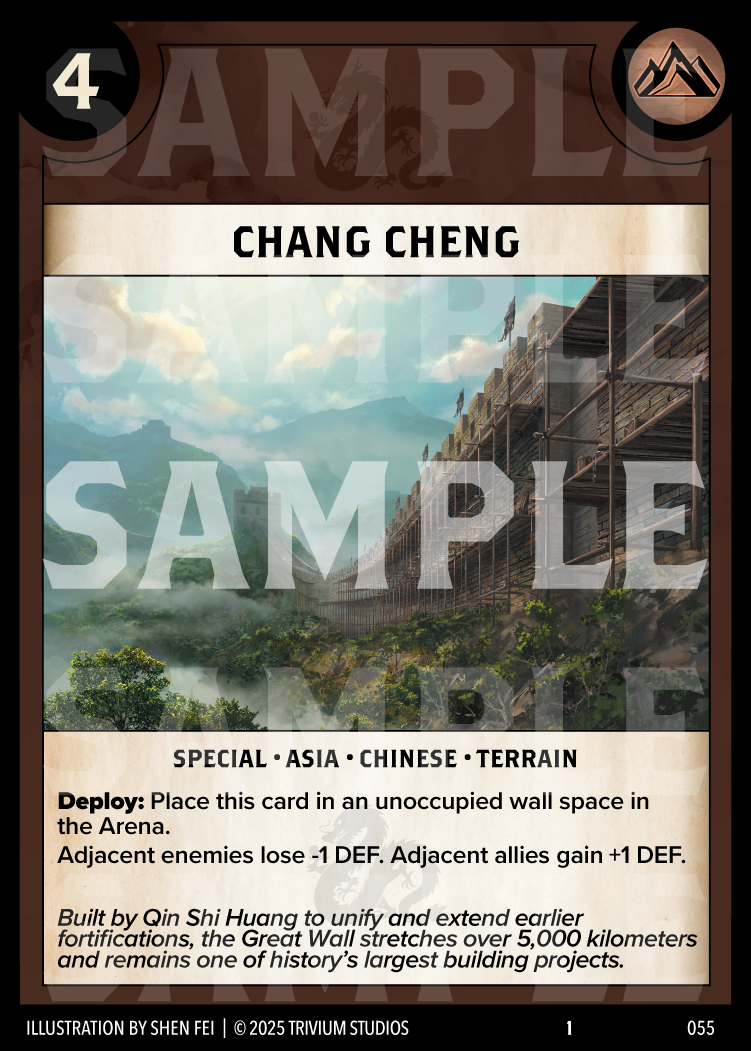
Standard
Special
Asia
Chinese
Terrain
Deploy: Place this card in an unoccupied wall space in the Arena. Adjacent enemies lose -1 DEF. Adjacent allies gain +1 DEF.
Built by Qin Shi Huang to unify and extend earlier fortifications, the Great Wall stretches over 5,000 kilometers and remains one of history's largest building projects.

The Great Wall associated with Qin Shi Huang refers to the unification and expansion of earlier regional fortifications into a coordinated defensive system along China’s northern frontier. Before unification, the states of Qin, Zhao, and Yan had constructed their own walls to guard against nomadic incursions. After 221 BCE, Qin Shi Huang ordered General Meng Tian to link and extend these defenses, creating a vast network of walls, forts, and garrisons spanning mountains, deserts, and grasslands.
Built primarily from rammed earth, timber, and locally available stone, the Qin wall was not a single continuous structure, but a system of fortifications integrated with watchtowers, signal stations, and military settlements. Its purpose was twofold: to deter raids by the Xiongnu confederation and to assert imperial control over newly conquered northern territories. The project demanded enormous labor from conscripted soldiers, convicts, and peasants, reflecting both the Qin state’s administrative capacity and the human cost of large-scale mobilization.
The Great Wall became one of the most enduring symbols of Qin Shi Huang’s reign. Although later dynasties — especially the Ming — rebuilt and expanded the wall using different materials and techniques, the Qin project established the concept of a unified northern frontier defense. Early texts emphasize the suffering endured by laborers, contributing to the wall’s dual legacy as both an engineering achievement and a monument to imperial burden.
Today, surviving Qin-era wall segments in regions such as Gansu, Ningxia, and Inner Mongolia are studied as part of the broader Great Wall complex recognized by UNESCO. Archaeologists analyze these remains to better understand early frontier administration, construction methods, and interactions between sedentary empires and nomadic societies. The Great Wall endures as a symbol of China’s historical vulnerabilities — and its capacity for monumental state action.