Encyclopedia Anachronistica

Standard
Special
Europe
Greek
Cavalry
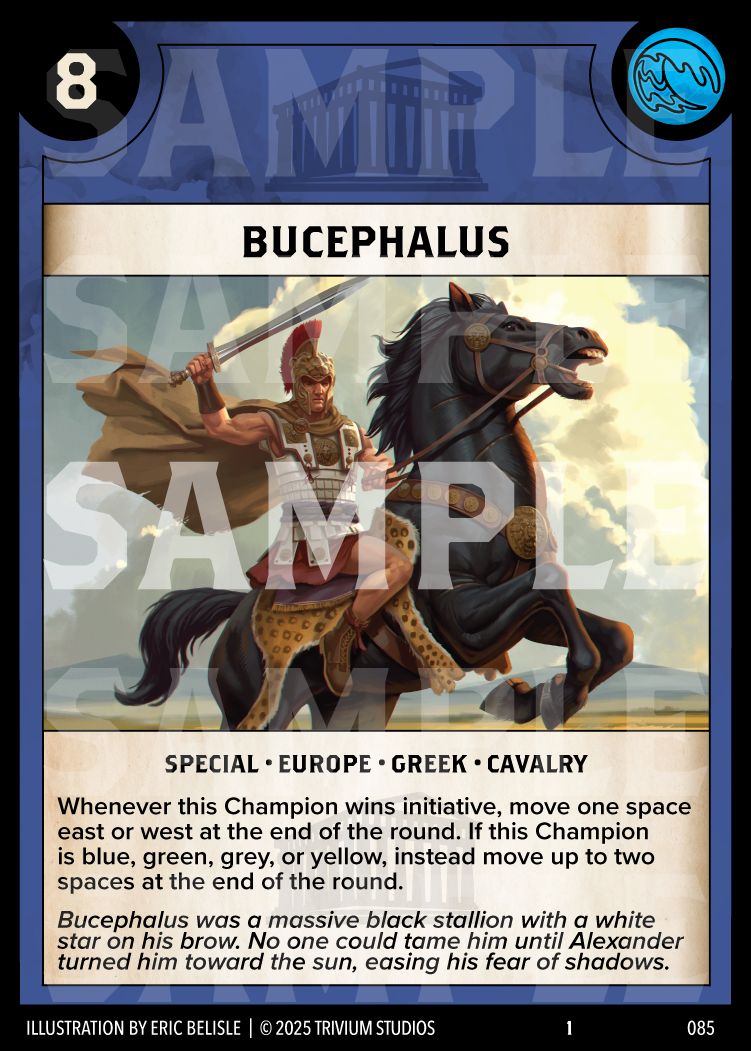
Whenever this Champion wins initiative, move one space east or west at the end of the round. If this Champion is blue, green, grey, or yellow, instead move up to two spaces at the end of the round.
Bucephalus was a massive black stallion with a white star on his brow. No one could tame him until Alexander turned him toward the sun, easing his fear of shadows.
Bucephalus, Alexander the Great’s famed war horse, is one of the most iconic animals in ancient history. Ancient sources describe him as a large, powerful stallion of Thessalian stock, marked by a distinctive white star and possibly a wall eye (heterochromia), a feature noted by Plutarch. His name, meaning “ox head,” may refer to his broad head, a brand, or a marking on his body—ancient authors themselves differ on its origin. According to Plutarch, the young Alexander tamed the horse by turning him toward the sun so he would not be frightened by his own shadow, a moment that became emblematic of Alexander’s intelligence, composure, and confidence.
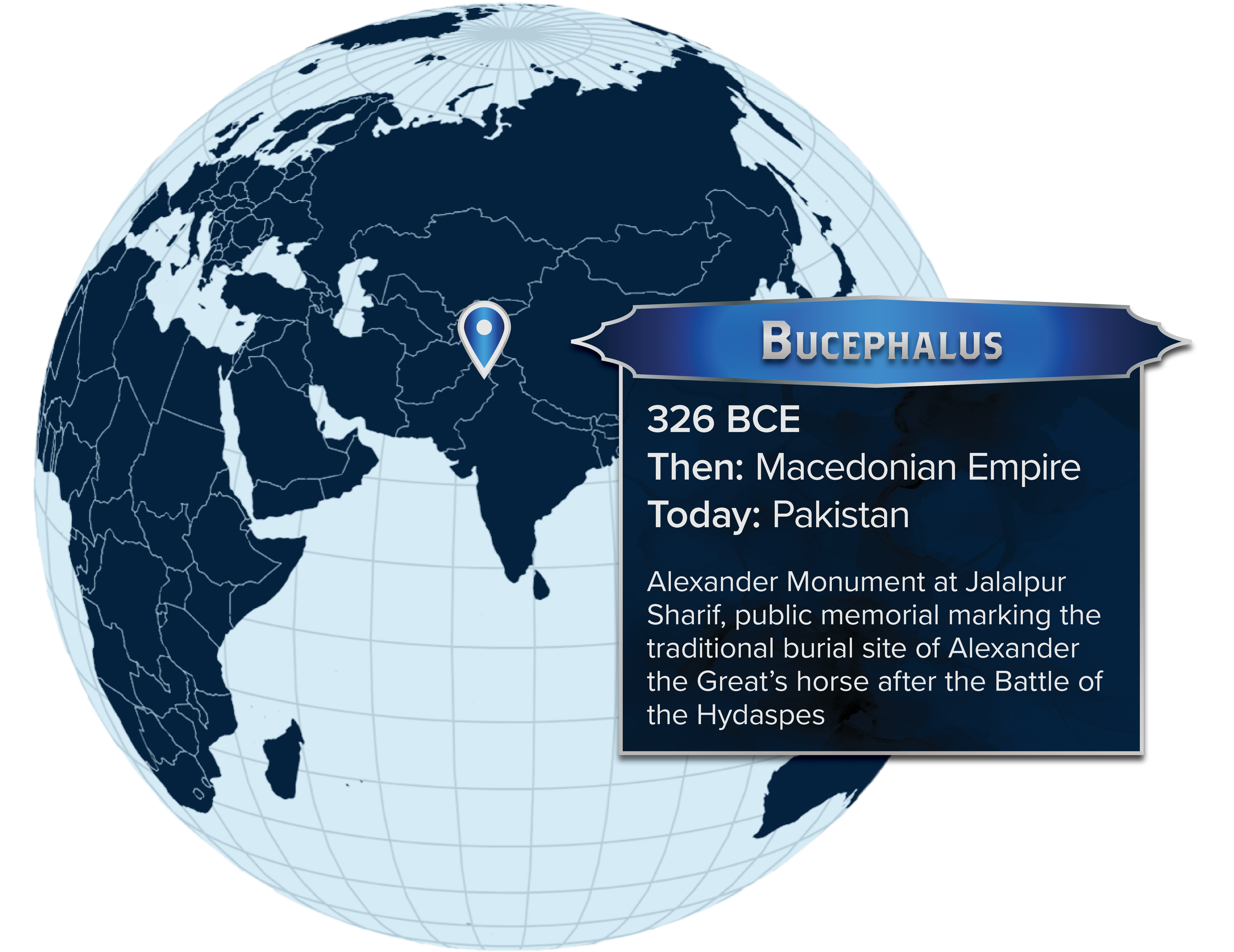
Bucephalus accompanied Alexander through much of his Asian campaign, carrying him in major engagements including the Granicus, Issos, and Gaugamela. The horse became inseparable from Alexander’s public image as a heroic warrior-king modeled on Achilles, fighting at the front rather than directing from the rear. Ancient accounts disagree on the circumstances of Bucephalus’s death—some claim he succumbed to wounds received at the Battle of the Hydaspes in 326 BCE, while others suggest he died of old age—but all agree that Alexander founded a city, Bucephala (or Alexandria Bucephalous), in his honor near the Hydaspes River.
The story of Bucephalus endures as a symbol of loyalty, leadership, and the bond between human and animal. Modern scholarship and popular retellings alike return to the tale to illustrate Alexander’s character and the central role of cavalry in Macedonian warfare. While the exact location of Bucephalus’s burial remains uncertain, the region near modern Jhelum in Pakistan preserves the tradition, reflecting the deep cultural afterlife of Alexander’s companion.