Encyclopedia Anachronistica


Standard
Special
Middle East
Caliphates
Shield
Gain +1 ATK against enemies without a revealed cavalry card. Enemies without a revealed cavalry card lose -1 base ATK against this Champion.
At Khaybar's fortress, Ali broke through the gate under heavy fire. Some accounts say he lifted it alone, turning a siege into surrender with strength and resolve.
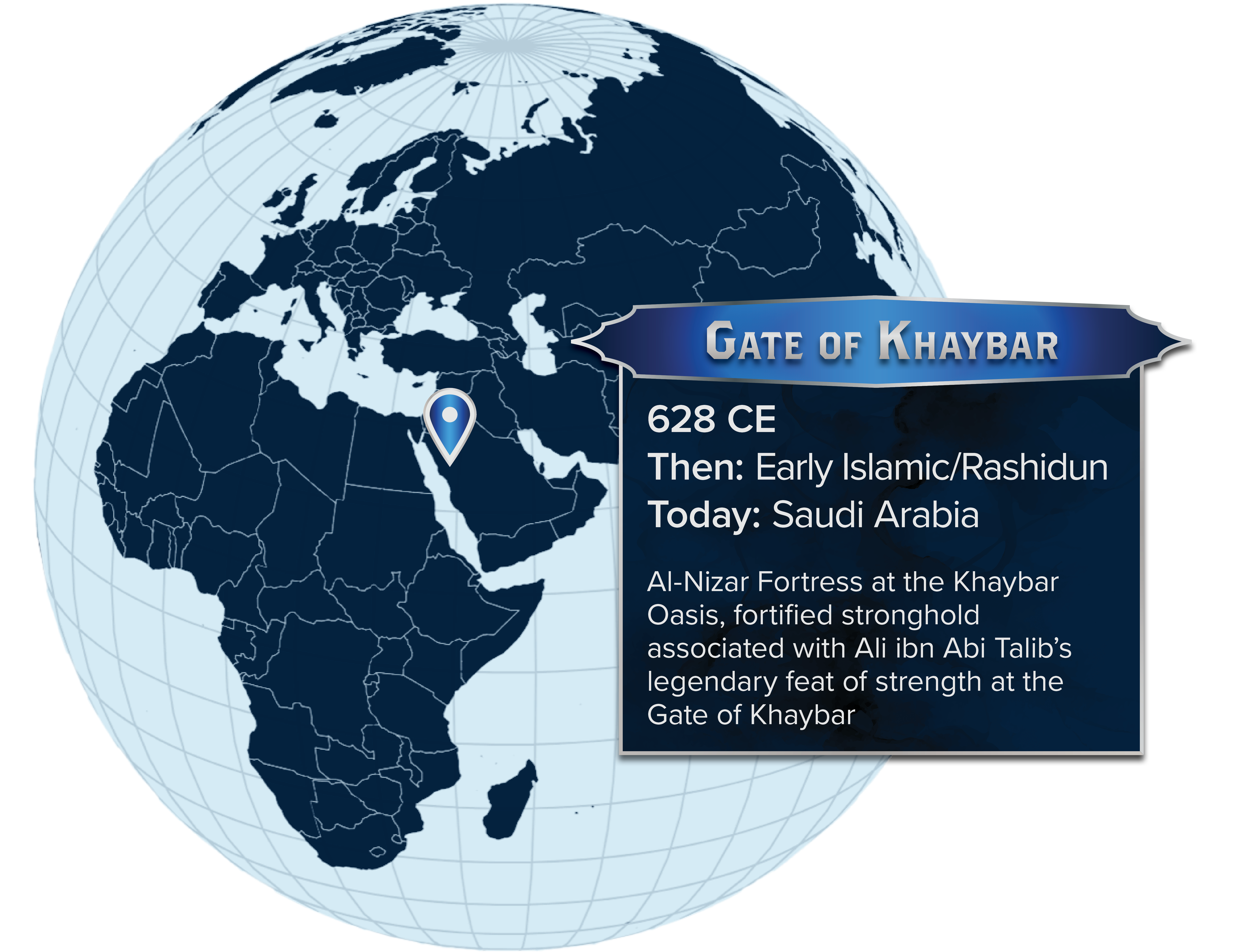
The Battle of Khaybar in 628 CE was one of the toughest challenges the early Muslim community ever faced. The Khaybar oasis was protected by a chain of stone fortresses, each reinforced with massive wooden gates designed to withstand fire, battering, and long sieges. In modern speak, Khaybar’s defenses were the medieval equivalent of a high-security vault—thick, heavy, and meant to buy the defenders time to regroup.
Ali ibn Abi Talib played the decisive role in the final stages of the campaign. Early historical sources like Ibn Ishaq and al-Tabari describe how the Muslims had struggled for days to break through the last and strongest fortress, known as al-Qamus. According to these accounts, Muhammad appointed Ali to lead the final assault. Despite suffering from a painful eye infection at the start of the day, Ali recovered, took up the banner, and led a fierce charge that finally secured the fortress. This victory was the turning point that ended the campaign.
The most famous part of the story—the dramatic image of Ali tearing a massive gate from its hinges and using it as a shield—appears in later Islamic tradition. While it’s a staple of medieval literature and art, this specific "superhuman" feat isn't found in the earliest 7th-century reports. Historians classify the "Gate Shield" as legendary material, reflecting the deep admiration later generations felt for Ali’s strength. Some versions of the legend say the gate was so heavy that eight men couldn't lift it later, emphasizing the miraculous nature of the act. These stories are essential to cultural memory, even if they aren't treated as eyewitness history.
Even without the legendary "gate-lifting," the Battle of Khaybar remains a masterclass in determination and strategy. Ali’s leadership reinforced his reputation as the person the community turned to in their most desperate moments of crisis. The gates themselves—vast structures of wood and iron—represent the literal "bottlenecks" of 7th-century warfare, where the outcome of an entire war often came down to who had the courage to break through a single, well-defended point.
Today, Khaybar is studied as a key moment in how early Islamic society navigated both conflict and diplomacy. The legends that grew around Ali show how communities preserve the "spirit" of their heroes, blending hard history with symbolic storytelling. Understanding both the tactical victory and the legendary gate reminds us that Ali’s legacy was built on real-world bravery that was so impressive, people eventually felt only a miracle could explain it.