Encyclopedia Anachronistica

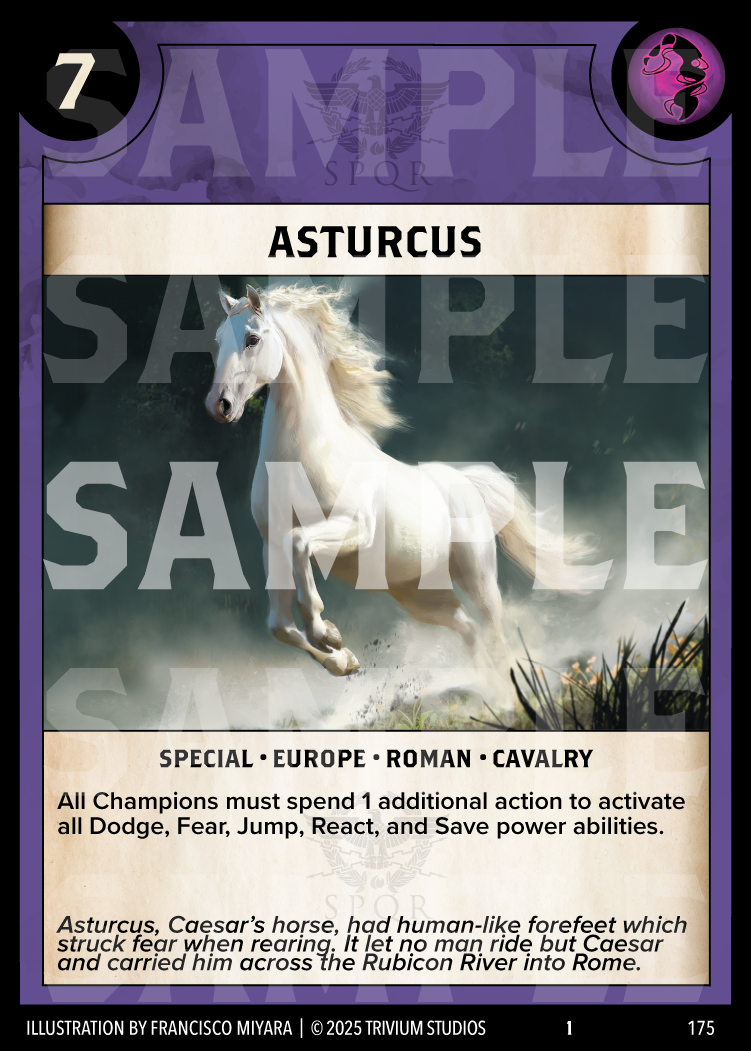
Standard
Special
Europe
Roman
Cavalry
All Champions must spend 1 additional action to activate all Dodge, Fear, Jump, React, and Save power abilities.
Asturcus, Caesar's horse, had human-like forefeet which struck fear when rearing. It let no man ride but Caesar and carried him across the Rubicon River into Rome.
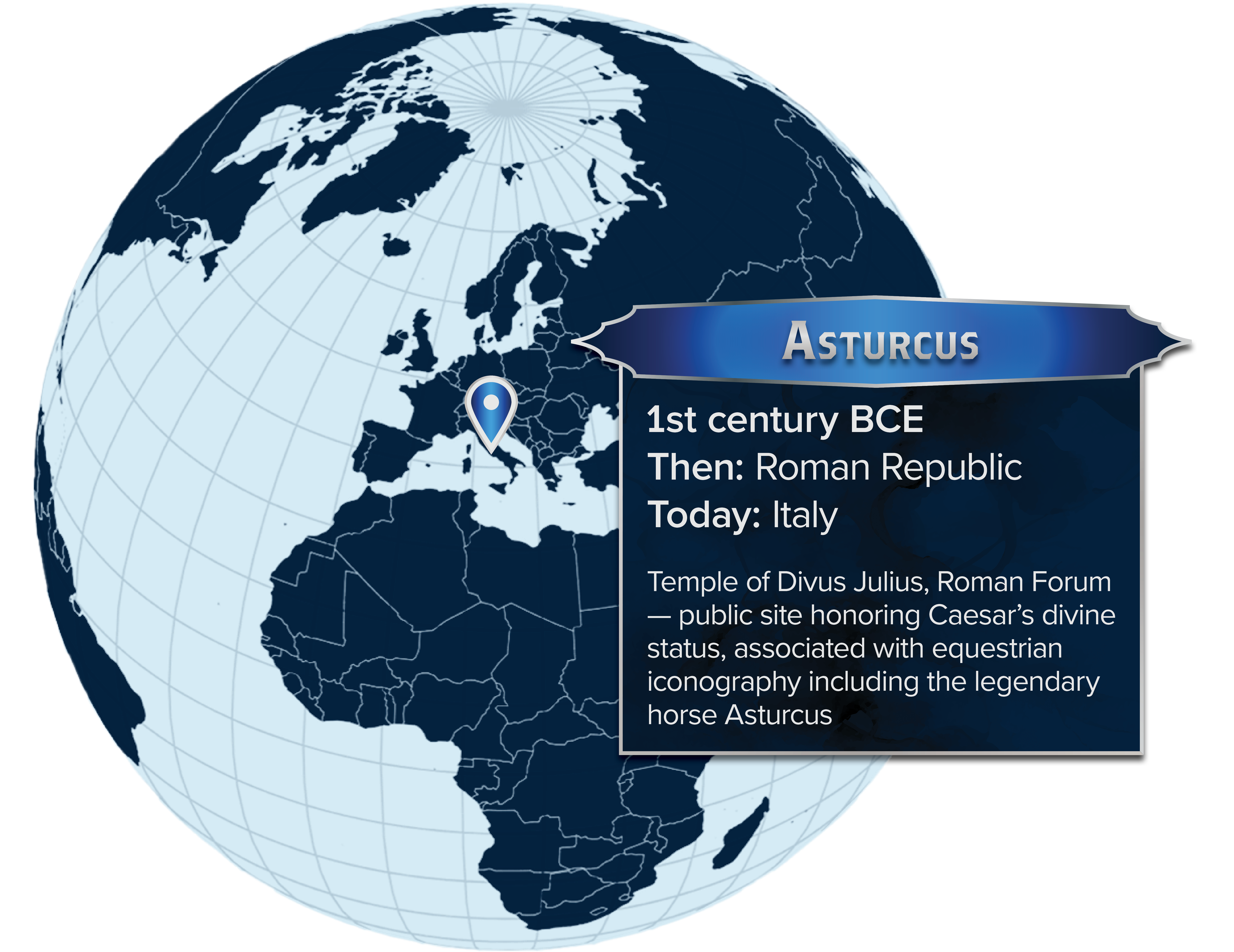
Students often imagine Julius Caesar galloping into battle on a statuesque, perfect stallion, but ancient accounts tell a much stranger story. According to the biographer Suetonius, Caesar’s favorite mount was a remarkable horse from Hispania that possessed front hooves split into "toes" that looked eerily like human feet. In the Roman world, where unusual animals were seen as divine omens, these "human-footed" hooves weren't considered a deformity; they were a prophecy. This horse, likely named Asturcus, became a living symbol of Caesar’s destiny. The legend was so powerful that Caesar eventually dedicated a statue of the animal in front of the Temple of Venus Genetrix, signaling to all of Rome that both he and his steed were marked by the gods.
The bizarre claim of "human forefeet" comes primarily from Suetonius, who wrote that the horse’s hooves were fissis unguibus—split into digits. While this sounds like a myth, modern historians and veterinarians suspect there is a biological grain of truth behind the oddness. The horse likely suffered from a rare genetic condition called polydactyly, where a horse is born with extra toes instead of a single solid hoof. In the ancient world, a horse with "fingers" would have been a terrifying marvel; today, we recognize it as an atavistic trait where the horse’s DNA accidentally "remembers" its prehistoric, multi-toed ancestors.
Beyond the strange anatomy, Caesar’s horse was a masterpiece of PR. The animal reportedly refused to let anyone but Caesar mount it, a detail that fit perfectly into his public image: a commander so charismatic that even the animal kingdom recognized his authority. In reality, this horse was likely an Asturian pony—small, sturdy, and incredibly agile. These weren't the towering warhorses of Hollywood movies; they were mountain-bred survivors built for the grueling terrain of Gaul and Spain. A horse like Asturcus was a high-performance off-road vehicle, capable of navigating river crossings and rocky ridges that would have broken a larger, prettier horse.
Today, the legend of Caesar’s multi-toed horse helps students understand how Romans blended cold, hard reality with supernatural symbolism. Caesar’s military genius didn't actually depend on a horse with toes, but the story was a tool he used to build his own myth. It’s a reminder that in Rome, history wasn't just about what happened on the battlefield—it was about how you spun the "miracles" of the natural world to prove you were the only man fit to lead.