Encyclopedia Anachronistica

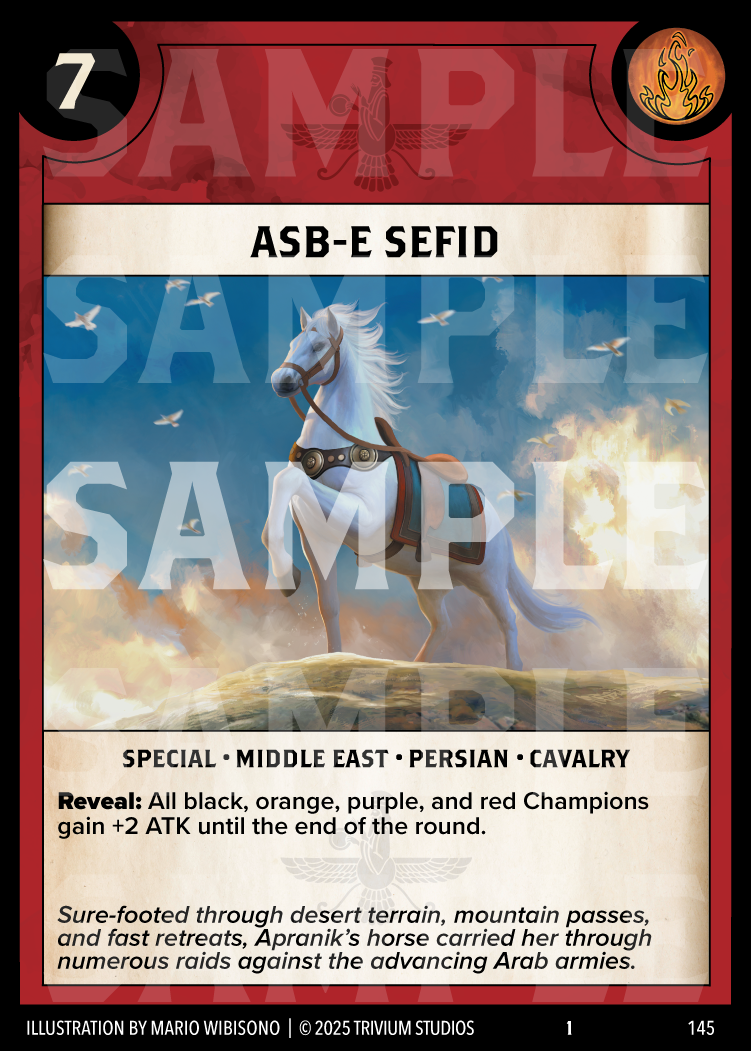
Standard
Special
Middle East
Persian
Cavalry
Reveal: All black, orange, purple, and red Champions gain +2 ATK until the end of the round.
Sure-footed through desert terrain, mountain passes, and fast retreats, Apranik's horse carried her through numerous raids against the advancing Arab armies.

A white horse standing against the ochre dust of the Iranian plateau is more than just a mount—it is a beacon. In Persian tradition, a white horse wasn’t just an animal; it was a symbol of Farr, or divine glory. While we don’t have a specific name for Apranik’s horse in the 7th-century records, the oral traditions and later Persian epics almost always place her on a pale steed. It links her visually to the great heroes of the Shahnameh, like Rostam, framing her not just as a soldier, but as a defender of the Persian soul itself.
The Sasanians were arguably the greatest horse culture of the ancient world. Their elite cavalry, the Savaran, were essentially the "fathers" of the medieval knight, training from a young age to master the lance and bow while wearing heavy iron mail. A horse in this era had to be an athlete: capable of carrying a fully armored rider across burning deserts and rocky mountain passes without faltering. A white horse, usually a rare and expensive breed, would have been an officer’s "living banner," making Apranik instantly recognizable to her troops in the middle of a chaotic skirmish.
Choosing such a visible horse was a massive act of courage. On a battlefield, a commander on a white horse is the primary target for every enemy archer. For Apranik, it was a statement of total resolve, she wasn’t hiding in the ranks; she was leading from the front. In the hit-and-run guerrilla warfare she practiced against the invading forces, her horse was her lifeline. It provided the speed necessary to vanish into the Zagros Mountains after a strike and the stamina to outpace pursuing columns.
Today, the image of the woman commander on the white horse remains a powerful motif in Iranian art and storytelling. It bridges the gap between the gritty historical reality of the Sasanian collapse and the timeless legends of Persian resistance. It serves as a reminder that even when an empire is falling, there are those who will ride toward the fire, turning themselves into symbols that endure long after the dust of battle has settled.