Encyclopedia Anachronistica


Standard
Weapon
Middle East
Caliphates
Sword
While this Champion has a revealed tome card, this weapon deals 1 additional damage.
This light, strong, curved-blade scimitar made of Damascus steel holds a legendary edge said to inspire fear and cut through silk, rock, and Crusader armor.
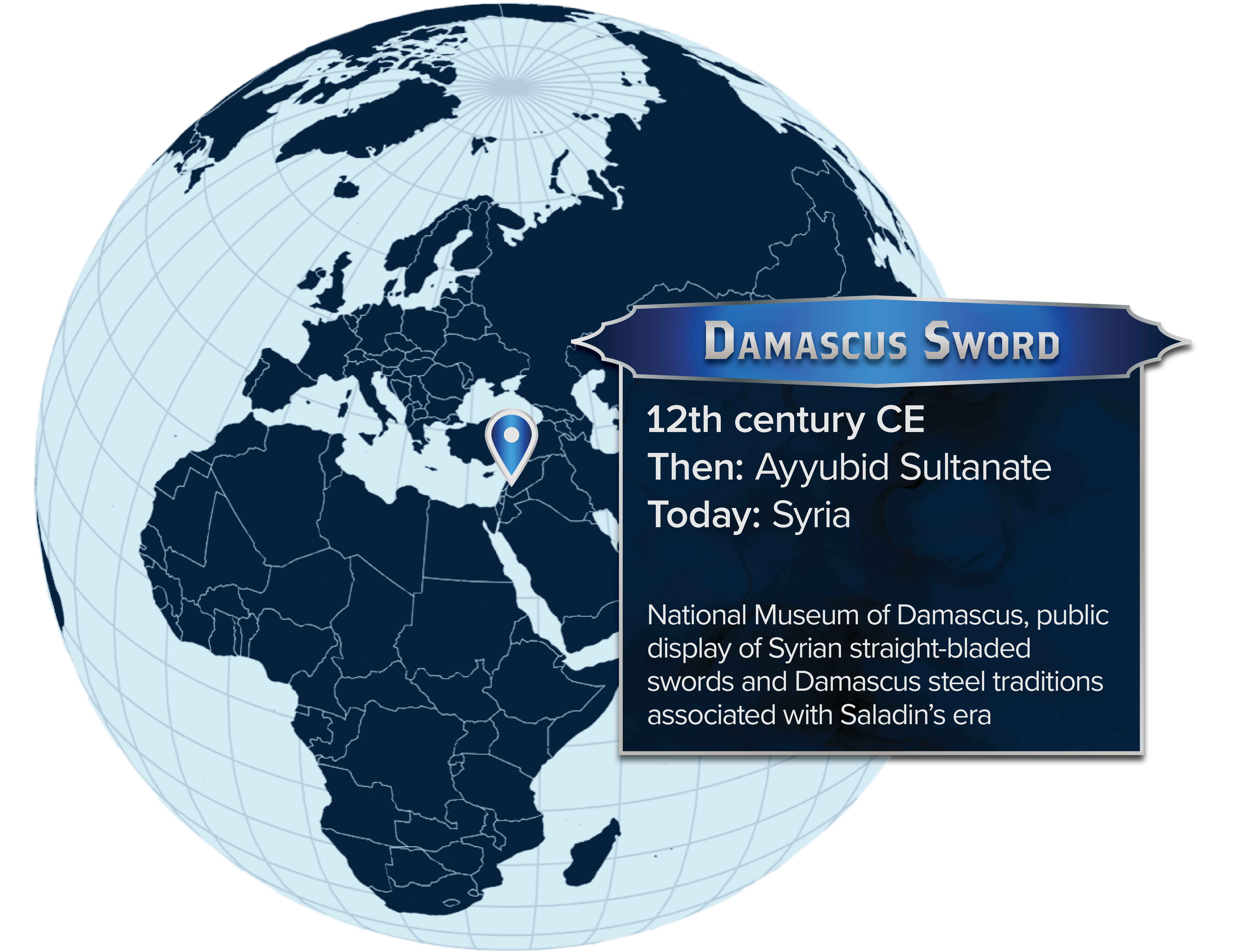
When we think of the legendary Sultan Salah ad-Din (Saladin in the West), we often imagine him wielding a curved, crescent-shaped scimitar. However, history tells a different story. The weapon Saladin carried into battle against the Crusaders was the Damascus Sword—a straight, double-edged blade that was the "super-weapon" of the 12th century. These blades were the pride of Damascus, forged using a meticulous process called pattern-welding that created beautiful rippling, water-like designs on the steel. In a world of brittle iron, a Damascus blade was like a piece of high-tech gear; it was famous for being flexible enough to bend without snapping, yet hard enough to hold a razor-sharp edge through an entire battle.
The design of this sword was masterful in versatility. Because it was straight rather than curved, it was a "dual-threat" weapon—perfect for a powerful downward cut from the back of a horse or a precise thrust during a frantic struggle on foot. Salah ad-Din, known for his humble and practical nature, didn't care for gold-encrusted showpieces. He wanted reliability. A Damascus-forged sword was a professional’s tool, built to survive the "meat grinder" of medieval warfare where armored cavalry and disciplined infantry collided in a storm of steel. It was the reliability of these blades that allowed Salah ad-Din’s forces to maintain their edge during the long, grueling campaigns to reclaim Jerusalem.
Over time, the legend of "Damascus Steel" grew to mythic proportions. Crusaders returned to Europe with tall tales of blades that could slice through a drifting silk scarf or chop an iron helmet in half. While those stories were likely "medieval clickbait," they were based on a very real truth: the Islamic world’s metallurgy was well ahead of Europe’s. The rippling patterns on the blade weren't just for decoration; they were the "DNA" of a folding process that made the steel uniquely tough and elastic. To the Crusaders, whose own swords were often heavy and prone to breaking, the Damascus sword seemed like it was made with magic.
Today, you can find these elegantly patterned blades in museum collections around the world, though finding one that definitely belonged to Salah ad-Din himself is the ultimate historical "needle in a haystack." These swords are more than just weapons; they are symbols of the Islamic Golden Age—a time when art, science, and technology were fused together. For students, the Damascus sword proves that Salah ad-Din’s strength wasn't just in his legendary mercy or his tactical mind, but in his appreciation for the world-class craftsmanship of his people. It’s a reminder that in history, the sharpest mind is often backed by the finest steel.