Encyclopedia Anachronistica

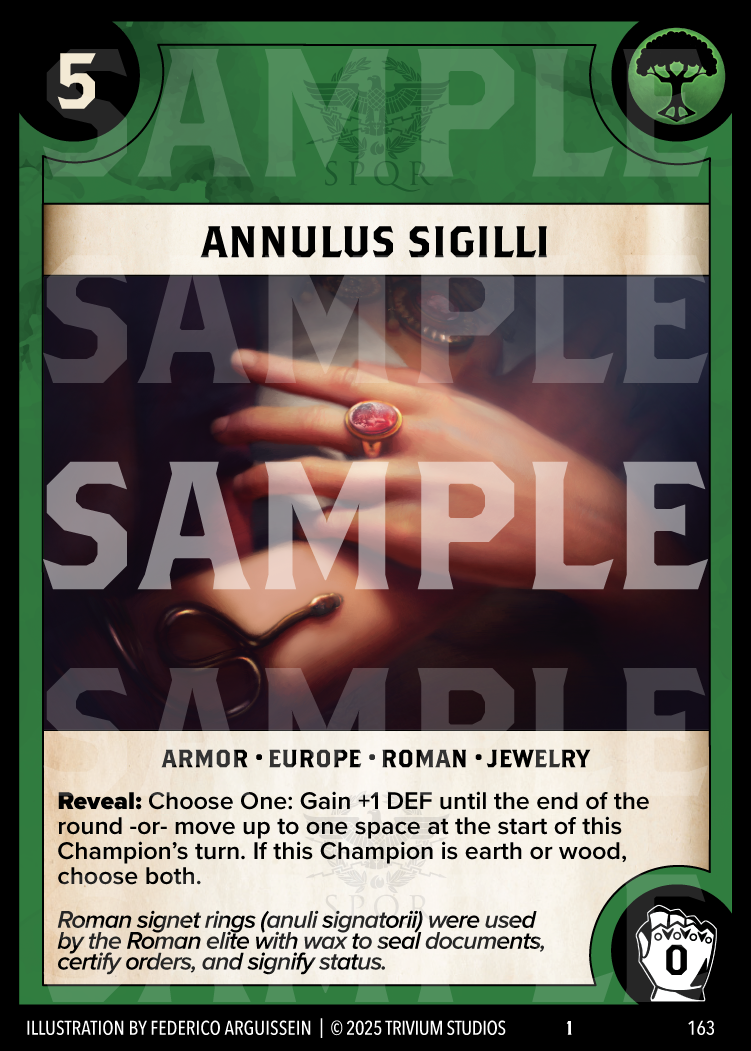
Standard
Armor
Europe
Roman
Jewelry
Reveal: Choose One: Gain +1 DEF until the end of the round -or- move up to one space at the start of this Champion's turn. If this Champion is earth or wood, choose both.
Roman signet rings (anuli signatorii) were used by the Roman elite with wax to seal documents, certify orders, and signify status.

Imagine a small, heavy ring pressed into warm wax, leaving behind a mark that could open doors, command soldiers, or seal a private message. In the Roman Empire, a signet ring was more than jewelry. It was identity, authority, and protection all in one. We do not have Agrippina the Younger’s personal ring, but as a member of the Julio-Claudian dynasty, she almost certainly wore one. Every elite Roman did. For someone of her rank, a signet ring was as essential as a signature is today.
A Roman signet ring usually held an engraved gemstone—often carnelian, amethyst, or onyx—carved with a unique design. When pressed into wax, the image acted like a personal stamp. Senators used them to seal official documents. Generals used them to authenticate orders. Imperial women used them to manage estates, send private letters, and conduct political business behind the scenes. Agrippina, born into the imperial family and later mother of an emperor, lived in a world where information was power. A signet ring helped her control that flow.
The designs carved into these rings varied widely. Some showed gods or heroes, others family symbols, and some displayed portraits. We do not know what Agrippina’s ring looked like, but surviving rings from her era give us clues. Many Julio-Claudian women favored images of goddesses like Venus or Ceres, symbols of fertility, beauty, and dynastic continuity. Others chose eagles, cornucopias, or mythological scenes that hinted at their lineage. Whatever Agrippina’s ring bore, it would have been chosen carefully to reflect her status and the message she wanted to send.
Signet rings mattered in Agrippina’s life because she operated in a political environment where written orders, secret alliances, and private correspondence shaped imperial power. Ancient writers describe her as ambitious and deeply involved in court politics. Whether those accounts are fair or exaggerated, she certainly managed estates, arranged marriages, and communicated with allies. A signet ring would have been the tool that allowed her to seal letters securely, ensuring that only the intended recipient could break the wax and read the contents. In a palace full of rivals, that mattered.
Today, signet rings from the Roman Empire appear in museums around the world. Students can see the tiny carved gems and imagine the hands that once pressed them into wax. These rings remind us that even in an age of emperors and armies, much of Roman power flowed through small, everyday objects. Agrippina’s world was shaped not only by public ceremonies and political drama but also by quiet moments—writing a letter, sealing it with a ring, and sending it into the uncertain currents of imperial politics. The signet ring stands as a symbol of how personal identity and political authority intertwined in the ancient world.