Encyclopedia Anachronistica


Chrono
Inspiration
Middle East
Caliphates
Ideology
Doors 1 of 4: Up to four Doors cards may be used this game. When this Champion wins initiative, deplete this card and gain +1 base ATK until the end of the round.
Revealed through Qur'an and Sunnah, Divine Law guides the soul and society. Its path weaves law, ethics, and worship into a divine order rooted in justice and mercy.
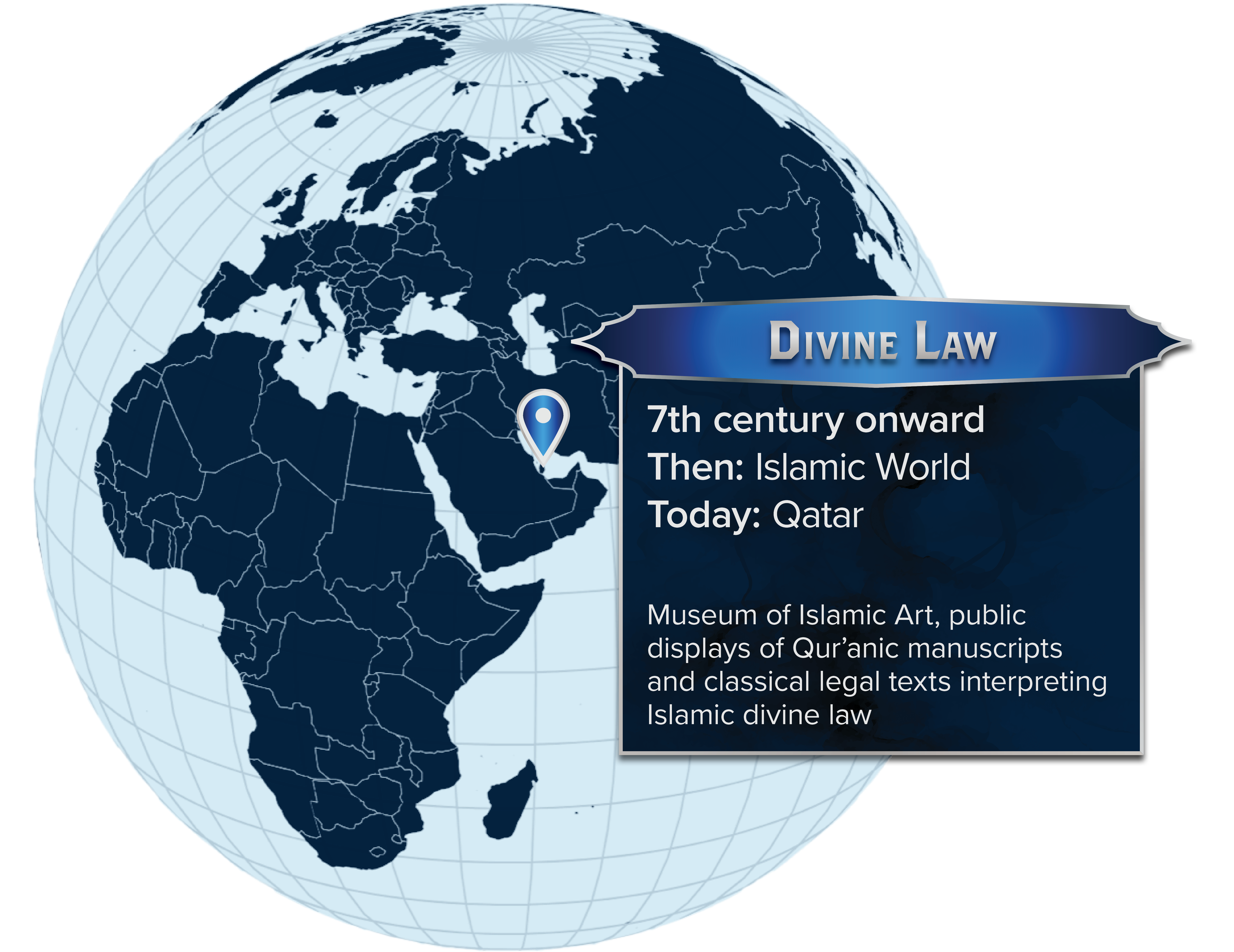
Across the early centuries of Islamic civilization, al-Shariʿa—Divine Law—took shape as both a moral compass and a complex legal framework. In the first generations following the Prophet Muhammad, Muslim communities relied on the Qur’an and the Sunnah to guide daily life, but as the empire expanded across continents, the need for more detailed interpretation grew. This necessity birthed jurisprudence (fiqh): the scholarly study of how law works, how rulings are derived, and how divine principles apply to real human situations.
By the 8th and 9th centuries, regional traditions crystallized into the four major Sunni schools—Hanafi, Maliki, Shafiʿi, and Hanbali. Far from being rivals, these schools coexisted as legitimate, parallel pathways for translating revelation into ethical judgment. Each brought its own methodological flavor: some prioritized local consensus or reason, while others leaned more heavily on a literal adherence to precedent. Over time, their rulings became the bedrock of courts, contracts, and family life, providing a consistent structure for a vast and culturally diverse world.
Yet the history of Shariʿa is not solely a matter of law—it is also a history of the spirit. By the 10th century, Sufi thinkers began to describe religious life as an inward journey that started with outward law but moved toward deeper truths. In Alevi and Ismaʿili traditions, this concept matured into the framework of the Four Doors and Forty Stations, a map of spiritual development that complemented the legal tradition:
While mainstream Sunni theology emphasized the external structure of jurisprudence to maintain social stability, these mystical traditions explored the internal landscape of the soul. Together, they reveal a civilization that balanced the communal need for law with the individual’s potential for enlightenment.
Al-Shariʿa stands at this crossroads of history. It represents the meeting point between the visible rules that hold a society together and the invisible milestones that shape a seeker’s inner world. It serves as a reminder that great civilizations endure not through raw power or territorial expansion, but through the ethical frameworks and spiritual quests that give human action its deepest meaning.