Encyclopedia Anachronistica


Standard
Weapon
Middle East
Caliphates
Polearm
When this Champion hits with this weapon, move one space left or right.
Forged in the martial traditions of Banu Makhzum, this lance became an enduring emblem of elite cavalry and Islamic conquest in the hands of the faithful.
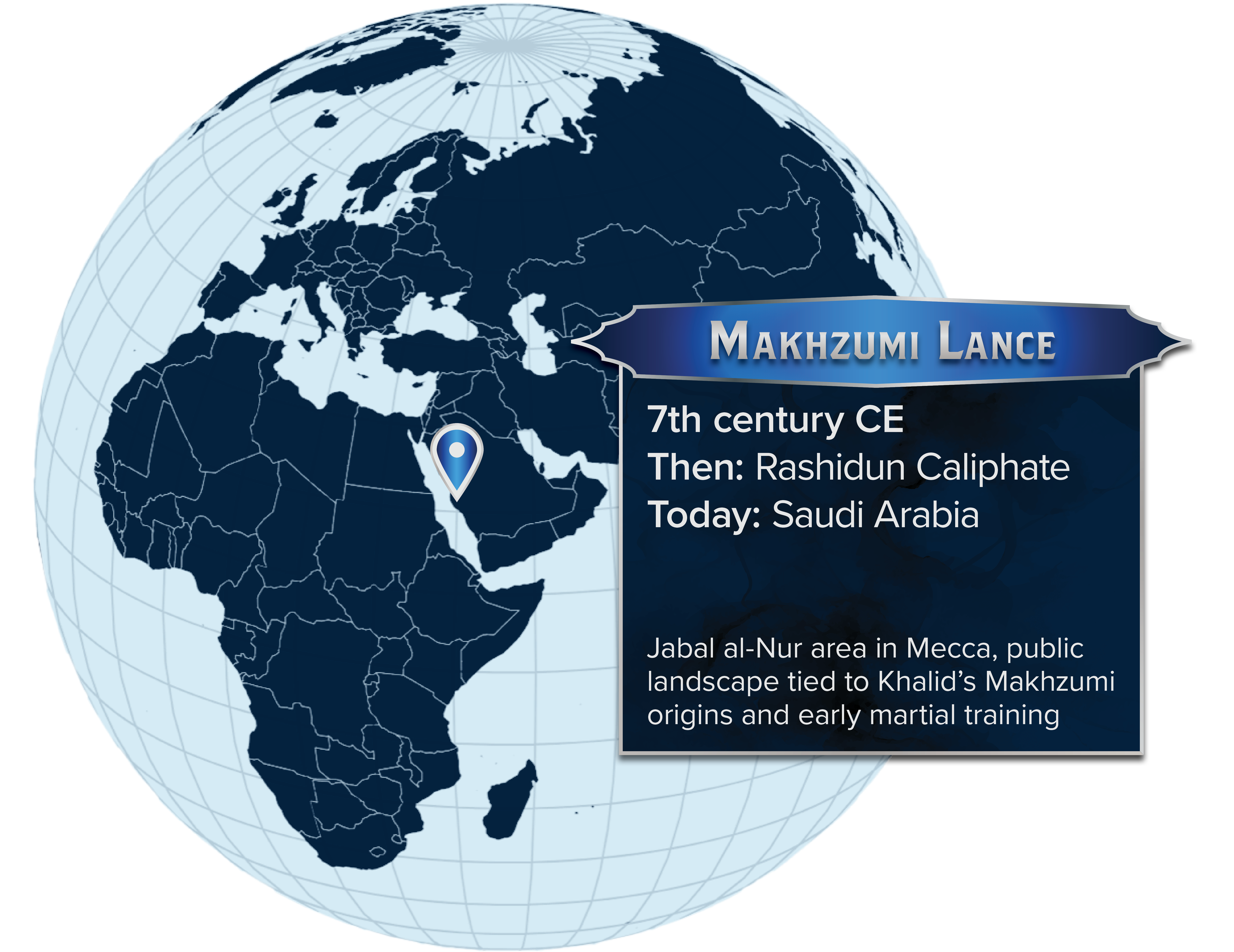
In the hands of the Rashidun cavalry, the lance—known as the mizraq or harbah—was less of a blunt instrument and more of a surgical tool. While the rival Sasanian "cataphracts" rode into battle on heavy horses carrying massive, two-handed pikes that were almost too heavy to turn, the Arabian lance was lean, light, and deadly. It featured a leaf-shaped iron head fixed to a flexible wooden shaft, designed specifically for a warrior who needed to strike at a gallop and then wheel his horse around in a heartbeat. For a commander like Khalid ibn al-Walid, this weapon was the key to a "hit-and-run" style of warfare that the lumbering empires of the 7th century simply couldn't catch.
Khalid’s elite "Mobile Guard" used the lance to turn the battlefield into a game of high-speed geometry. Because the mizraq was light enough to be handled with one hand, a rider could keep his other hand on the reins, allowing for the dizzying maneuvers that made Khalid famous. Early Arabic poetry often describes warriors carrying a "bundle" of spears: they might hurl a shorter javelin to break an enemy’s focus before closing the distance to deliver a precise thrust with their main lance. It wasn't about the brute force of a head-on collision; it was about the speed of the sting.
Beyond its lethality, the lance served as a 7th-century GPS. In the dust and chaos of a desert battle, a commander’s long spear, often topped with a distinctive banner or "lima," acted as a rallying point for his men. If you saw Khalid’s lance moving toward a gap in the enemy lines, you knew exactly where the hammer was about to fall. While we don't have Khalid’s personal spear today, the iron spearheads found in museums across the Middle East show a high level of craftsmanship—sharp, durable, and balanced for a life on the move.
Today, the mizraq helps us visualize why the early Islamic spirit was so hard to pin down. It was a weapon built for a community that valued agility over weight and strategy over sheer size. It reminds us that Khalid ibn al-Walid didn't just win because he was brave; he won because he mastered a tool that allowed him to move faster and strike more accurately than anyone else on the field. The lance wasn't just a piece of wood and iron—it was the lightning bolt of the "Sword of God."