Encyclopedia Anachronistica

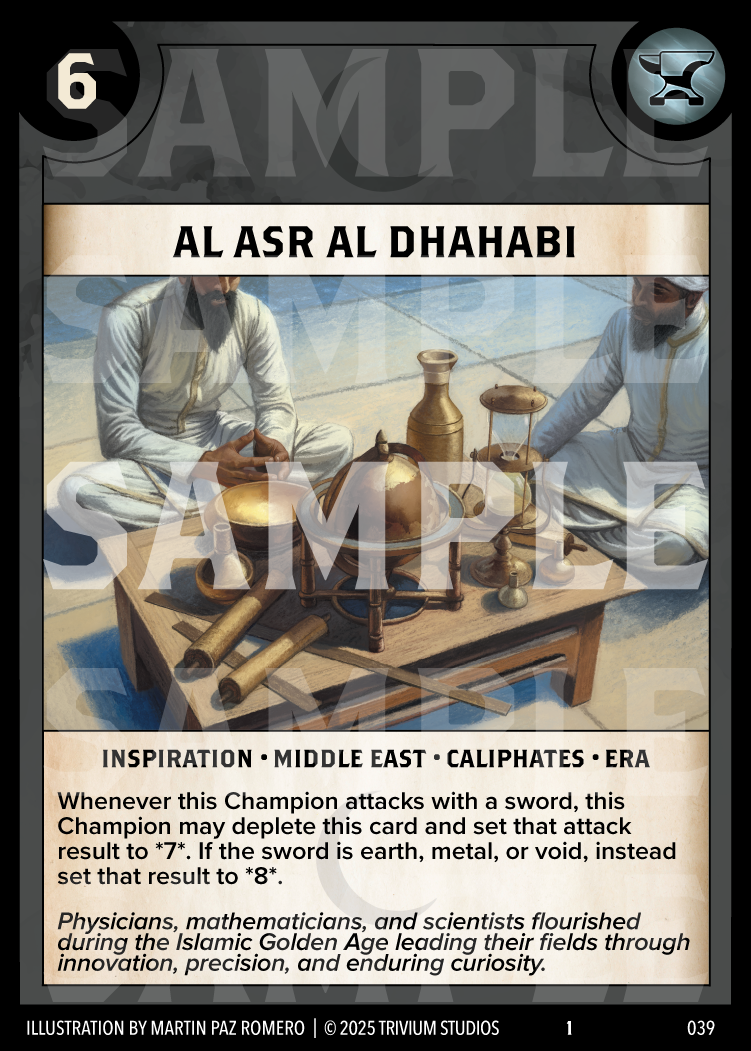
Standard
Inspiration
Middle East
Caliphates
Era
Whenever this Champion attacks with a sword, this Champion may deplete this card and set that attack result to *7 *. If the sword is earth, metal, or void, instead set that result to *8 *.
Physicians, mathematicians, and scientists flourished during the Islamic Golden Age leading their fields through innovation, precision, and enduring curiosity.
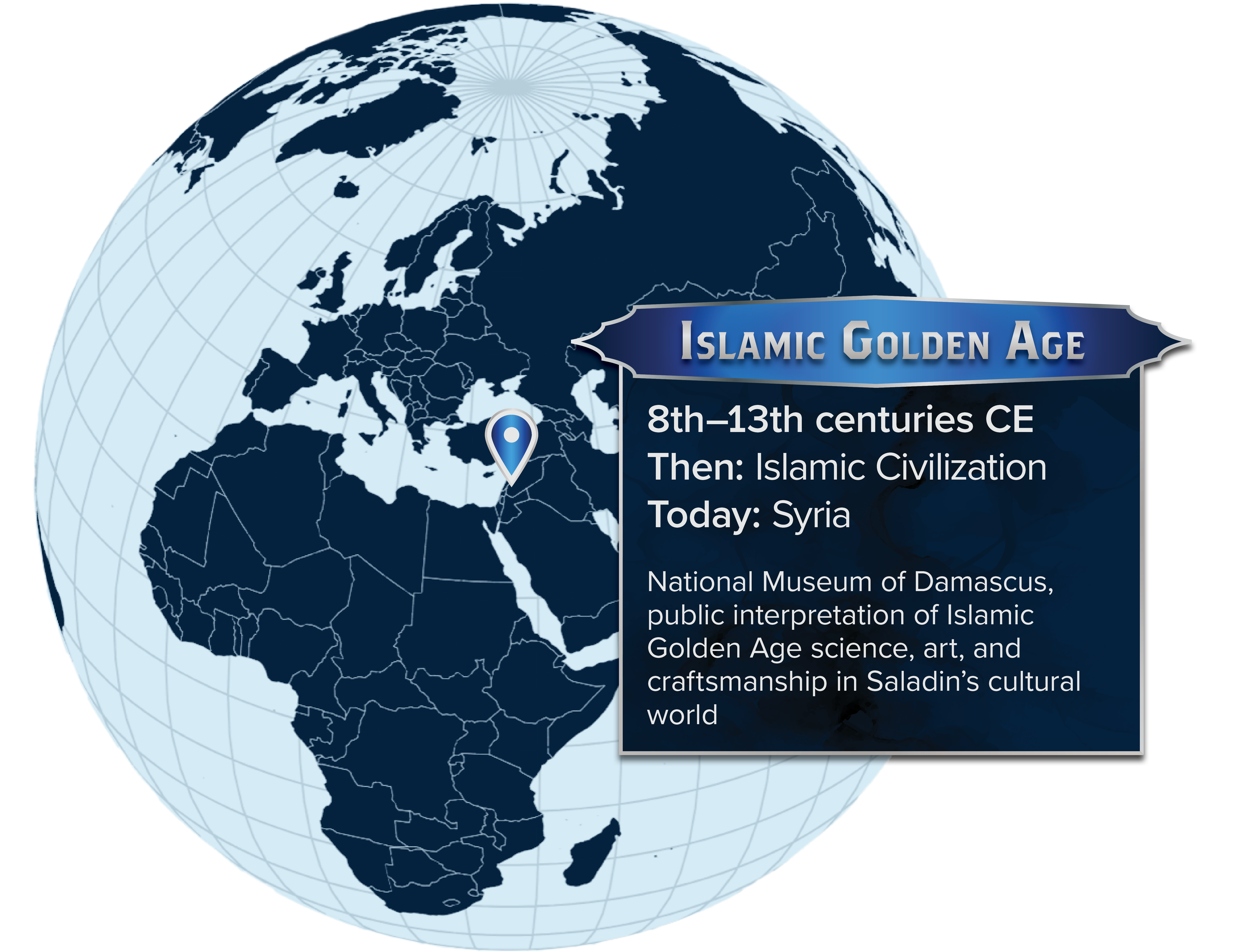
Imagine living in a world where your local doctor is reading the latest breakthroughs in surgery, your architects are using advanced geometry to build soaring arches, and your blacksmiths are essentially "nanotechnologists." This was the reality for Salah ad-Din. He wasn't just a general leading an army; he was the protector of the Islamic Golden Age. During the 12th century, cities like Damascus and Cairo were the "Silicon Valleys" of the medieval world. While much of Europe was struggling through the Early Middle Ages, Salah ad-Din’s territory was a global headquarters for astronomy, medicine, and engineering. To understand the man, you have to understand the brilliant, high-tech world he was fighting to keep safe.
This intellectual explosion directly powered Salah ad-Din's military success. His camp wasn't just filled with soldiers; it was packed with specialists. He was served by physicians trained in the medical traditions of legends like Ibn Sina, ensuring his troops had the best healthcare available at the time. His engineers didn't just "build" siege engines; they used ancient Greek and Persian mathematical texts to calculate the physics of catapults and the strength of city walls. Even the famous Damascus steel carried by his officers was a product of this scientific culture—a perfect blend of chemistry and craftsmanship that produced weapons far superior to anything the Crusaders brought from the West.
But the Golden Age influenced more than just Salah ad-Din’s weapons; it shaped his soul. This was an era of "Ethical Leadership." Philosophers like al-Ghazali were writing books about how a true leader should be humble, just, and merciful. Salah ad-Din was a known bookworm who studied these works deeply. His famous decision to spare the citizens of Jerusalem and treat his enemies with respect wasn't just a personality trait; it was an application of the high moral standards taught in the libraries of Damascus. He was a "Scholar-Sultan" who believed that a ruler’s greatest duty was to embody the wisdom found in his books.
Today, you can see the remnants of this incredible era in museums from Cairo to Istanbul—shimmering brass astrolabes used to map the stars, medical surgical kits that look surprisingly modern, and beautifully inked manuscripts. These artifacts remind students that Salah ad-Din’s world wasn't a dark or primitive place. It was a society that valued the pen as much as the sword. For Salah ad-Din, defending his empire meant defending a legacy of human knowledge that still shapes our world today.