Encyclopedia Anachronistica

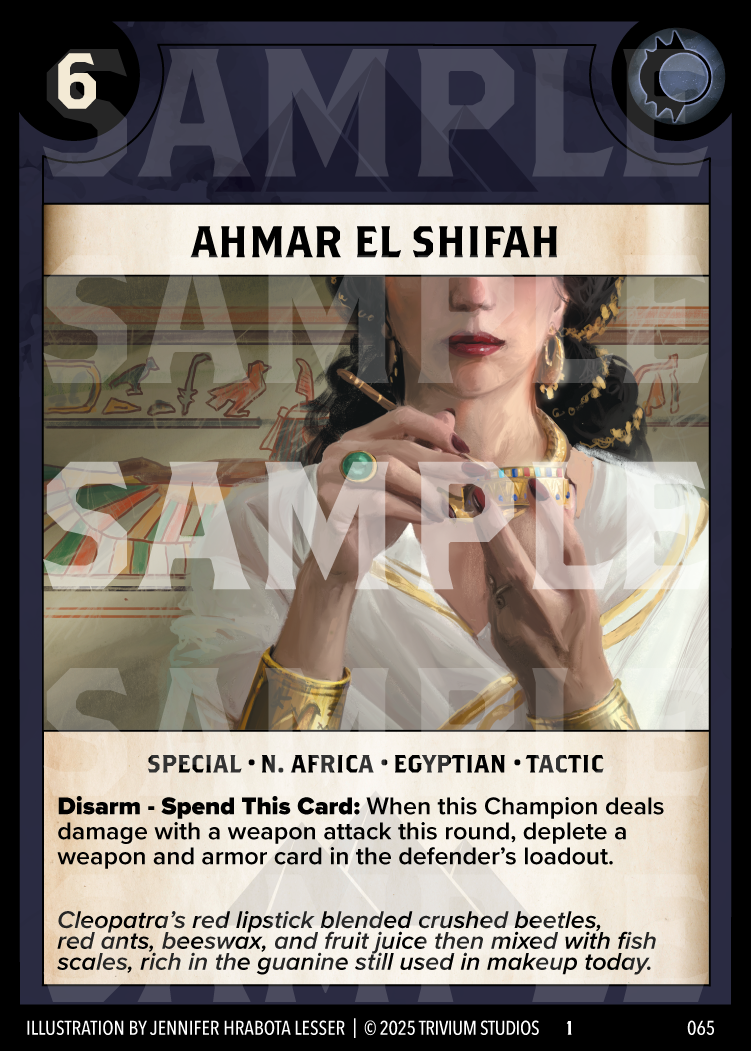
Standard
Special
N. Africa
Egyptian
Tactic
Disarm - Spend This Card: When this Champion deals damage with a weapon attack this round, deplete a weapon and armor card in the defender's loadout.
Cleopatra's red lipstick blended crushed beetles, red ants, beeswax, and fruit juice then mixed with fish scales, rich in the guanine still used in makeup today.

Cleopatra VII’s reputation as a "seductress" is one of the most successful smear campaigns in history. To see her only as a romantic figure is to miss the far more impressive truth: she was a high-level strategist who used her appearance—from her red lipstick to her tone of voice—as a tactical weapon. In the ancient world, cosmetics weren't about "getting ready"; they were about sovereignty. For an Egyptian queen, using red pigments like ochre wasn't a fashion trend—it was a way to claim the "divine vitality" of the gods.
Even the Roman writers who hated her had to admit that her real power wasn't just her face. The historian Plutarch, who lived shortly after her time, wrote that her beauty wasn't actually incomparable, but her presence was irresistible. She was a brilliant polyglot who spoke at least nine languages and could discuss philosophy, economics, and military strategy with the most powerful men on Earth. When she used cosmetics, she was simply setting the stage for her intellect to do the heavy lifting.
The "temptress" label was actually a clever invention by her Roman enemy, Octavian. To convince the Roman Senate to declare war on her, he had to paint her as a dangerous, foreign witch who used "magic" and "charms" to steal the minds of Roman generals. This was a classic political hit job. Octavian knew that if he admitted Cleopatra was simply a better politician than him, he would look weak. By turning her into a "seductress," he made her power seem like a trick rather than the result of her hard work and education.
One of her most famous moves was her meeting with the Roman general Mark Antony. She arrived on a massive barge with purple sails, surrounded by the scent of expensive perfumes, dressed as the goddess Aphrodite. This wasn't a date—it was psychological warfare. Before Antony could even say hello, she had already dominated the environment. She proved that if you control the stage, you control the conversation.
Today, we can look at Cleopatra’s red lipstick and elaborate presentation as the armor of a woman who refused to be underestimated. She used every tool at her disposal—tradition, symbolism, and science—to protect her kingdom in a world run by men with massive armies. Cleopatra didn't flirt her way into the history books; she commanded her place in them through pure, calculated intelligence.